BlockTech — Product information pack
How it works · Technical information · Supply and interfaces · Installation and maintenance
- Language
- English
- Version
- 1.1
- Prepared
- 2026-11-02

BlockTech uses connected polymer elements to create underground storage. The surrounding enclosure and outlet arrangement determine whether water is released gradually, retained or infiltrated into the soil.
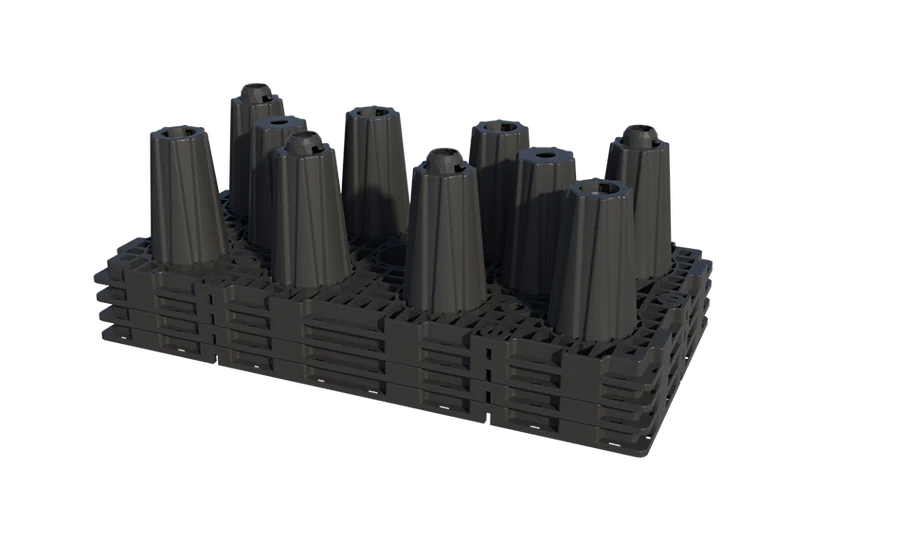
The catalogue identifies four elements: main module, fixator, side panel and sectional lid. Modules form the reservoir structure; perimeter elements support the enclosure. The selected layout must accommodate inlets, outlets and inspection access.
Attenuation temporarily stores runoff and releases it through a controlled outlet. Retention keeps water for a defined purpose. Infiltration releases suitable water into the ground. The catalogue illustrates permeable geotextile for infiltration and a geotextile–geomembrane–geotextile enclosure for storage; the enclosure, seams and outlet are specified for the project.
Main modules, fixators, side panels and sectional lids form the described structure. Enclosure materials, inspection access, inlet/outlet connections, pretreatment and flow controls must be identified in the proposal; do not assume all are included in a module price.
The catalogue sequence covers base preparation, enclosure, modules and fixators, perimeter elements, inspection points, enclosure checks and backfill. It is an overview, not a site instruction. Loading, cover, ground and groundwater require design checks. Plan sediment management, inspection and cleaning access before installation.
These product information packs describe construction, functions, interfaces and source reference data. They are not certificates or approved installation instructions.
How it works · Technical information · Supply and interfaces · Installation and maintenance
Values apply to the main module, not a complete reservoir or its accessories. The module is a polymer element.
| Length (mm) | 1000 ± 2 |
|---|---|
| Width (mm) | 500 ± 2 |
| Height (mm) | 250 ± 2 |
| Module mass (kg) | 5.4 ± 0.2 |
| Nominal external volume (m³, calculated) | 0.125 |
(1000 / 1000) × (500 / 1000) × (250 / 1000) = 0.125 m³
The source states a 95% working-volume fraction for the assembled reservoir. It does not give a net water capacity for an individual module or every layout. The selected reservoir capacity depends on the arrangement and operating levels; 0.125 m³ is the external geometric envelope, not useful water volume.
No. Attenuation delays discharge, retention holds water for a purpose, and infiltration returns water to the soil. The enclosure and outlets must match the selected function.
No. Soil, groundwater, water quality and the applicable drainage requirements must support it.
No. A location under parking does not establish allowable loading or cover. Use evidence and design checks for the selected configuration.
The proposal must identify modules, locks, perimeter elements, enclosure, access, connections and any pretreatment or outlet controls, with exclusions.
Blank project brief, revision 2026-10-07. Record values, units, sources and open items; this worksheet contains no product specifications.
Download the editable project-input worksheet (CSV)